Instead of posting a bunch of pictures from this event, I decided to record some video. I hung out with the friendly folks at the IAC Chapter 67 tent for most of the time throughout the week and for the airshow made it out to the front of the crowdline.
First up is a video I put together of a friend and fellow IAC 67 member, Terry Burch! He always puts on an incredible airshow routine in his beautiful Zlin 50LA. Sit back and enjoy:
Next up is a video showcasing all of the acts that participated in this years 2008 Arlington Fly-In and Airshow! Celebrating the 40th annual Arlington Fly-In! The Arlington Fly-In takes place at Arlington Municipal Airport in Arlington, Washington.
Enjoy:
Performers Shown In Video:
Kent Pietsch - Interstate Kadet
Ken Fowler / Eric Hansen - Rocket Aerobatics - Harmon Rocket
Renny Price - Su-29
Bud & Ross Granley T-6 Texan/ Yak-18/ Yak-55
Frank Donnely - Dr. D's Old time Aerobatics
Red Eagle Air Sports - Christen Eagle II
John Mrazek - Harvard Mk IV
Dan Buchanan - Hang Glider
Terry Burch - Zlin 50 LA
Kathy Hirtz - Wolf Pitts
Julie Clark - T-34 mentor
P.S. Youtube left out the last 6 seconds of the video, which provided time to pause and read the performers list. It's originally 4:08

Showing posts with label Fly-In. Show all posts
Showing posts with label Fly-In. Show all posts
Thursday, August 14, 2008


Friday, September 14, 2007
Pure Magic! First aerobatic training flight
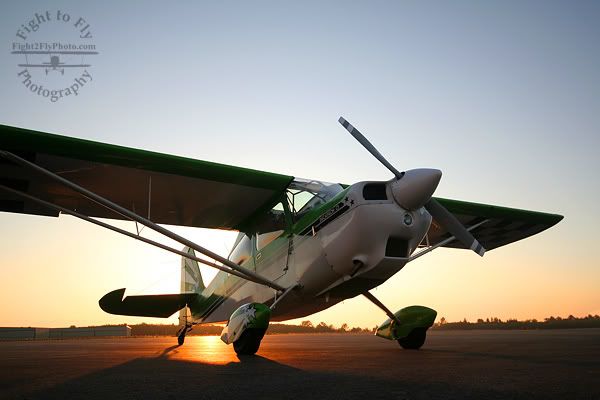
This is the airplane I'm training in, taken yesterday after my first aerobatic training flight! Beautiful airplane, isn't it?

Wow, there isn't a word in any language that can appropriately describe what that first flight was like. I've imagined that first experience countless times before in my head and none of them matching how incredible it was in real life.
From the beginning:
Matt arrived at the airport and we went up to one of the flight school offices to discuss what we would be doing for this first flight. He went over each maneuver we would do which included steep turns, slow flight, rudder turns (more on this later) falling leaf, stalls, spins, aileron rolls, and loops. He went through each maneuver describing power settings control inputs, what and where to look, and what it might feel like. I personally have read several books on the topic of aerobatics and everything he said echoed what I had already heard--which is a good thing! I'm not one who likes surprises, especially in the air!
After that was all said and done, we went out to the airplane and he briefed me on wearing the parachute and how to operate it in an emergency. He also briefed me on the harness system, door hing release mechanism and when to use them. (only when the airplane is physically unable to be controlled, IE. wing falls off) I felt he was very thorough. I've had experience wearing parachutes before when I worked at Harvey Airfield. I was able to go up in a Cessna Caravan for skydive flights and was required to wear a 'chute even though I was riding with the pilot.
Inside the plane- All strapped in and ready to go! Since I don't have my tail wheel endorsement and have very little experience in them all together he did the takeoff and landing but let me do the taxiing. The nice thing about the Decathlon is the fact you can actually see over the nose while taxiing, so it wasn't too difficult. Takeoff was quick and smooth and we were on our way up to 3,500 feet!
Upon reaching our intended altitude I started things off by doing some steep turns to the left and then to the right. Again this just gets me used to all the controls in the airplane, and gets my head "outside" the cockpit, looking for traffic and again, getting used to how things look from this airplane. My first turn was to the right and that was fine, but when I did my turn to the left, I found myself always wanting to descend. I realized about half way through that I didn't have to compensate for sitting in the left hand seat! In a Cessna the sight picture for a left steep turn is much different from that of a right hand steep turn because the seating is side-by-side. So I fixed that problem and all was well.
Then we slowed things down a bit and learned how the airplane felt in the backside of the envelope. The airplane was still very responsive and quite pleasant. One thing I began to notice at about this point is my right leg, for who-knows what reason, would tense up and would start pressing on the right rudder pedal. Every time I noticed this I'd relax it and continue what I was doing. After a while this went away. It was odd because at no time during the flight was I really anxious or nervous. Throughout the flight I made a conscious effort to keep a gentle grip on the controls. I've learned through personal experience in my flying that a tight grip on the controls leads to over-correction and sloppy flying. From what I've read that problem is multiplied when one performs aerobatics.
Rudder turns. This maneuver was simply to get me used to playing with the rudder and to show how much it authority it has on the airplane. We cruised around at about 90 mph and then I simply smoothly applied right rudder. Instantly the airplane wants to roll to the right, but part of the exorcise is to keep the wings level. So that required left stick. I was quite shocked to see just how much aileron deflection it required to keep the wings level while performing this 360 degree "flat" turn. I did this both to the left and the right.
Next up, stalls! Now I did several power on and power off stalls. For those unfamiliar with aviation terms, power on and power off simply refers to how much power is applied during the maneuver. Power off simply has the throttle at idle or near-idle power. Power on, for this flight, was just about 1,800 RPM. I got to see how the aircraft reacts to stalls and how to recover them. Again, it gradually gets me used to unusual attitudes and how the airplane reacts in different situations. Recovery is really simple, just move the stick forward and use the rudder to keep the wings level and the airplane coordinated.
Falling Leaf. This is a maneuver where the goal is actually to keep the airplane in a stall and control it with the rudder. On this flight we couldn't really get the airplane to stay in a stalled condition, but I was still able to get a good idea of how the airplane reacts to rudder inputs.
Now the fun begins: Spins! I had only been in one spin before this flight and it was a demonstration in a Cessna 150 about seven years ago. All I remembered about it was the fact it was freakin' fun! I was kind of anxious as to how I'd feel about doing these spins. Matt did one first, walking me through the process. Then he had me talk him through what I was going to do and then it was up to me. Prior to doing this myself the first time I still felt a bit weird about spinning an airplane, intentionally. For all my life I've been trying to avoid these! But, nonetheless, I slowed the airplane down, power to idle, kept bringing the stick back, slower, slower, stall horn goes off, full left rudder, full aft stick, and around I went!! Then after about 1 rotation I applied full right rudder, forward stick, spinning stopped, stall stopped, then recovered to level flight and added power to climb back up and do it again! As soon as the airplane was "flying" again I thought to myself, "That was freakin' awesome! Lets go again!" So then I did one to the right, and was quite surprised at how much faster the airplane rotates when doing a spin to the right! My instructor seemed to be impressed with the fact I was recovering from these spins on almost the same heading as when I began them. After about the second spin I had done myself I was able to sit there and count the turns in my head and know where I was in the spin. After doing several 1 and 1.5 turn spins Matt had me go beyond that to 2 and 3 turn spins. Again this was much different as at takes about 1.5-2 turns for the airplane to settle into the spin. For that early phase the rotation actually accelerates and then stabilizes in turns 2 and beyond. We did one 5 turn spin to test the theory of whether the airplane would actually recover itself from the spin, which, it did not. It may have to do with a further aft CG, and also some take longer to recover than others. But it didn't seem like the airplane was willing to help out as that stick was pressed firmly all the way back. This was the only time I felt weird during the flight but it was only dizziness from spinning around so fast. It wasn't nearly to the point of being disorienting and I was still able to control the aircraft just fine.
Rolls! After I got my fill of spins for this first flight, we moved on to aileron rolls. These were so much fun! Nothing like seeing that horizon rotate right in front of you! Doing these was pretty simple, pitch the nose down to reach 120mph, pitch up about 30 degrees, then simultaneously move the stick all the way over to one side while applying rudder in the same direction. Rudder only really needs to be applied during the first and last portions of the maneuver, but I seemed to have kept it in throughout the entire thing. Just as you begin to reach inverted it's also a good thing to add a bit of forward stick, causing you to rise up out of the seat momentarily and continue on to finish the maneuver. For a lot of these I was actually able to finish the maneuver right where I began. But there were still a few that seemed kind of odd due to inaccurate rudder use.
After having done about a dozen of those in either direction we moved on to loops. Now this was a blast too! (I know, I say that after everything) I couldn't believe how 4 g's felt when doing this! It was awesome! We pitched the nose down pretty good, then abruptly bring the stick back into our laps to pitch the nose up nice and fast. For the first little bit of the loop you look out the front, then once the horizon is no longer visible you shift your scan to watch the horizon dance around the left wingtip. This is the only real way to know where you are in the loop. Then once you are about 45 degrees inverted above the horizon you ease the pull and push the stick forward a bit to float over the top and lift out of the seat for a moment. At this point you tilt your head back and look out the top of the aircraft to watch the horizon and finish out the maneuver with another significant pull to level. For these I seemed to be a bit timid on the initial pull and the float over the top needs some work. But hey, it's my first flight! :) I need some reason to come back, right? (Ha! like I need a reason! I'm addicted!)
After doing several more of those, and some more aileron rolls I asked to do some inverted flight, just for fun. This was quite awesome. It was simply a two point aileron roll. I was surprised at how much forward stick was required to keep the airplane flying level, and to be honest, it didn't feel that bad! (I say this with ignorance because that was only -1G. I'm quite certain my opinion will change once I get anywhere beyond -1G!)
So, after that we landed, had a very brief debriefing and that was that! My first aerobatic flight under my belt! For the next flight we're going to do steep lazy-8's (wing overs basically), more spins, aileron rolls, loops, and the practice some 2 point rolls and some unusual attitude recovery exorcises.
Monday, July 16, 2007
Arlington EAA Fly-In.
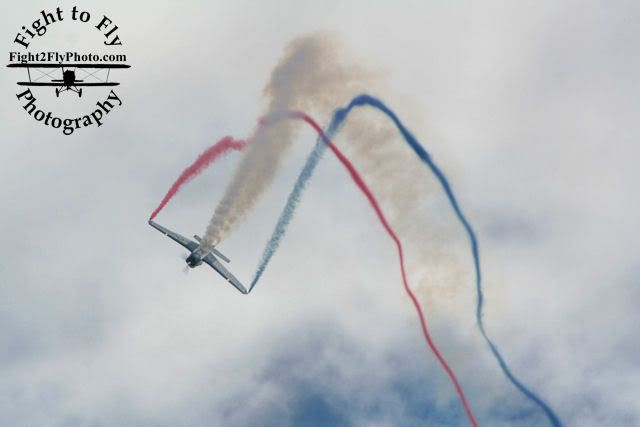
The Arlington Fly-In proved to be another great show for 2007. Arriving only for the Sunday show, I was greatly surprised as to the lack of attendance. There were very few aircraft as most pilots moved out earlier in the day. When it comes to photography, I couldn't ask for a better situation! No heads in the way at all!
The airshow lineup included local legends Bud and Ross Granley performing their formation routine, Julie Clark and her T-34, warbirds including the P-51 Mustang, P-47 Thunderbolt, and A-1 Skyraider. One act I saw for the first time this weekend was Red Eagle Air Sports. They are a two-ship formation aerobatic team who dazzles crowds in their Christine Eagles. The rest of the show included Kathy Hirtz, Eric Hansen, John Mrazek, Renny Price, Dr. Frank Donnelly, Ken Fowler, and Dan Buchanan.
I'm quite bummed that I am only able to watch Bud Granley fly twice this summer. Unfortunately both the Abbotsford International Airshow and Oregon International Airshow are booked on the same weekend. Due to costs and other factors I will be down in Oregon while Bud flys up in Canada.
As far as photography goes, conditions were absolutly perfect! The sky was partially sunny which provided a great background for pictures. As I mentioned in a previous blog, I really don't like having a plain blue background.
Sunday seemed to be an "off" day for me, though. Out of 1,300 pictures I only kept around 300. I intentionally used a slower shutter speed on most of the pics which meant fewer keepers. This is when I really wish I had a lens with IS!! The steady 15 kt wind didn't help matters either, as the large lens on the Sigma 50-500mm acts like a sail in the wind.
Overall I'm still satisfied with the outcome as it was good practice for the upcoming shows I will be attending when people will actually be paying for my services.
To see more great pictures from this show, please view my online gallery by clicking here.
Saturday, June 23, 2007
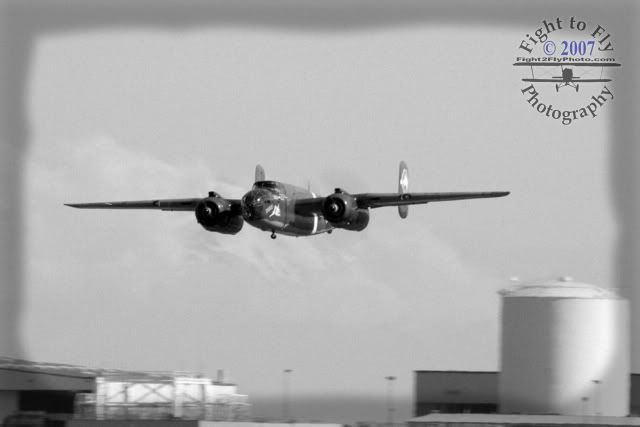
Collings Foundation Bombers....
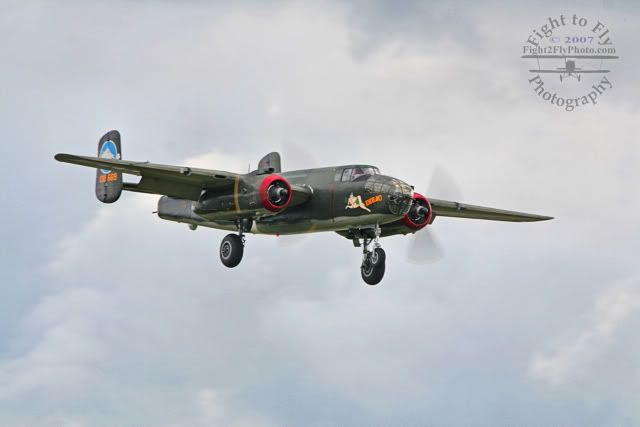
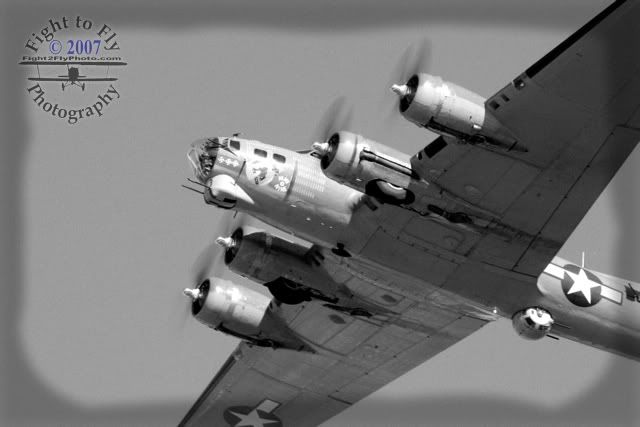

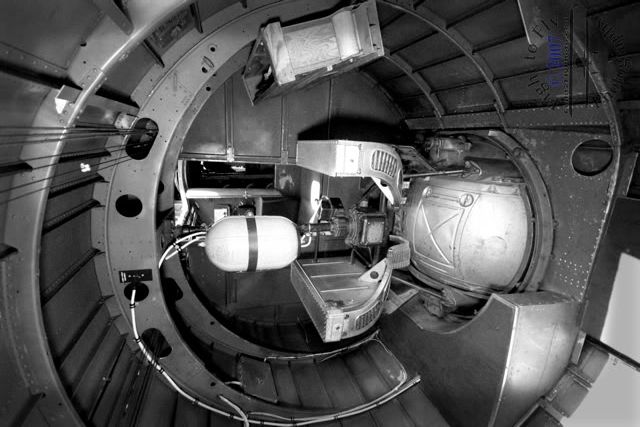
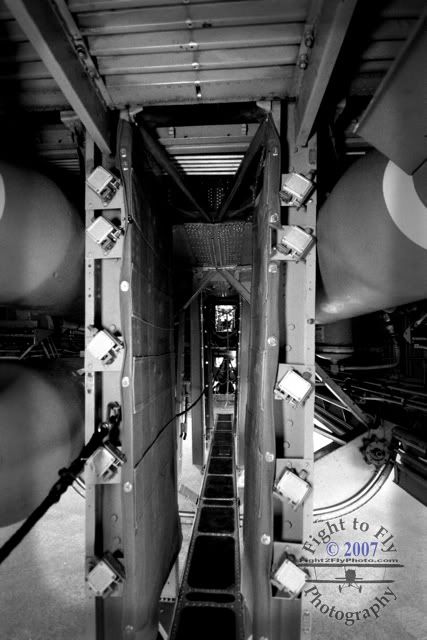
I've gone through the B-17 and B-24 in the past and was just amazed then as I am now to see just how cramped it is inside these airplanes. It's obvious they weren't designed with comfort in mind. I was initially wearing my camera bag backpack when I got inside the B-17 and quickly realized there simply wasn't enough room to maneuver through the cramped interior. To get from the front of the aircraft to the back you have to walk through a tiny walk-way that goes through the bomb-bay.
The sound these beautiful machines make is pure music. The ground shakes as their radial engines turn over and roar to life. It was such a treat being able to hear these airplanes for the last three days at work.
To view and order prints of the photos I took of these magnificant airplanes, please click here.
Saturday, April 28, 2007
Tulip Festival Fly-In!
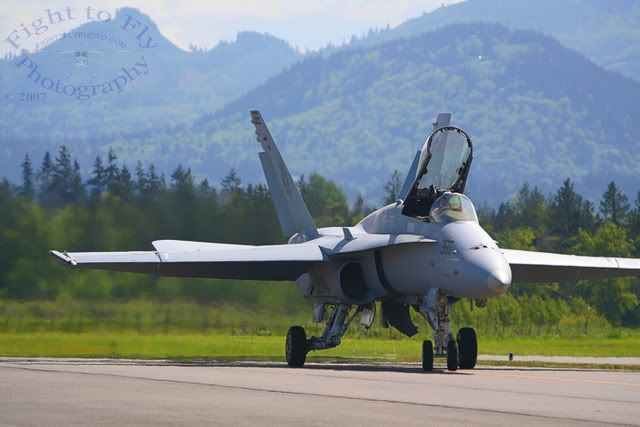 Skagit Regional Airport hosted the second biannial Tulip Festival Airshow and Fly-In on April 28th.
Quick Review:
In the weeks leading up to the show I was quite surprised to find they actually had the West Coast F/A-18C Hornet team on the schedule! Unfortunately the FAA wasn't able to grant them airspace clearance to do the full tactical demonstration, but the pilots took both ships up for some section (formation of two aircraft) flyby's and touch and goes.
As for military demonstrations, they also had a SAR helicopter (MH-60) from NAS Whidbey Island perform.
The show also featured Bud and Ross Granley, a father-son aerobatic team. One flys a Yak-55 and the other flys a Yak-18 and put on an incredible show!
Warbirds are always popular at smaller airshows such as this and they did provide a pretty good showing. There were four T-6 Texans (aka: SNJ, Harvard) two T-28's, and several other aircraft. There weren't any "big" showbirds out such as a P-51, but it was still a good lineup and provided some very crowded skys!
Photography:
The showline looks directly at the sun the entire time which means you're going to have a tricky time getting properly exposed pictures. Thanks to computer technology it is pretty easy to fix these issues.
Capturing good pictures of the static display, on the other hand, was pretty easy as there really weren't a lot of people around to ruin shots.
Overview:
Great show! Especially for this early in the season it's a great time to make sure you still know how to use your camera equipment after the long winter months. :) One of the greatest parts of this show was the chance to meet several friends in person for the first time! (You know who you are!)
More Pictures:
Subscribe to:
Posts (Atom)